Announcement Description
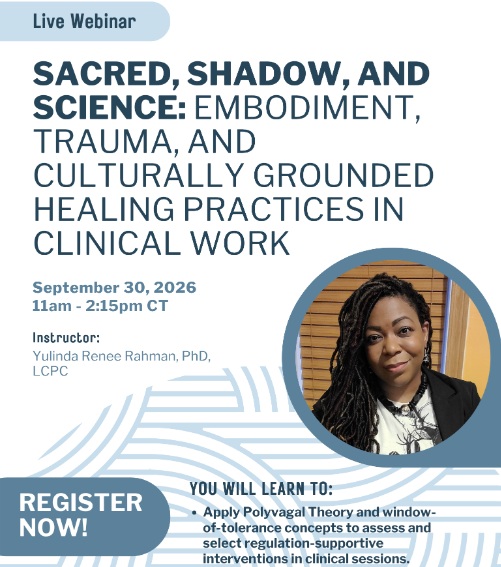
Sacred, Shadow, and Science: Embodiment, Trauma, and Culturally Grounded Healing Practices in Clinical Work
Presented by Yulinda Renee Rahman, PhD, LCPC
Wednesday, September 30, 2026
8am-11:15am PT / 11am-2:15pm CT / 12pm-3:15pm ET
Event held online via Zoom, link to access provided upon registration.
This advanced clinical training examines the intersection of trauma, embodiment, and culturally grounded meaning-making in therapeutic practice. Organized around three integrated frameworks — Sacred, Shadow, and Science — the program supports clinicians in expanding their interpretive range when working with clients whose healing processes draw from spiritual, ancestral, somatic, and culturally situated traditions. Drawing on trauma-informed care (Ranjbar et al., 2020), Polyvagal Theory (Porges, 2011), Somatic Experiencing (Levine, 2010), and body-centered approaches to racialized trauma (Menakem, 2017), the program positions cultural and embodied experience as central to effective trauma treatment. Clinicians will examine how meaning-making systems, shame dynamics, nervous system regulation, and somatic awareness each contribute to the arc of trauma recovery, and how clinical interpretation is shaped by the practitioner’s own cultural and epistemological frameworks.
The program introduces three clinical lenses applied sequentially and in integration.
The Sacred section examines how clients construct meaning through spiritual, ancestral, and culturally rooted frameworks and how practices such as ritual, intentional breathwork, and symbolic language function as regulatory and integrative mechanisms.
The Shadow section examines the role of shame, disowned experience, and adaptive survival strategies in trauma presentations, using four clinical archetypes: the Wounded Protector, the Fragmented Self-State, the Over-Adapted Self, and the Control-Seeking Part as orienting frameworks for clinical recognition and response.
The Science section draws on Polyvagal Theory (Porges, 2011) and window-of-tolerance concepts (Ogden et al., 2006) to examine how the autonomic nervous system mediates threat response, social engagement, and the conditions under which trauma can be processed and integrated. It is worth noting that Polyvagal Theory has generated substantive scientific debate, particularly regarding its neuroanatomical claims about the functional distinction between dorsal and ventral vagal pathways and its evolutionary framing (Grossman, 2023; Grossman et al., 2026). These critiques are active in the peer-reviewed literature and have not been fully resolved. However, researchers and clinicians have distinguished between the theory’s specific physiological claims, which remain contested, and its clinical heuristic value, which has been broadly affirmed (Giroux et al., 2023; van Lith et al., 2024).
This program treats Polyvagal Theory as an organizing clinical framework for understanding how clients move between states of activation, shutdown, and regulated engagement, not as a fixed biological truth. Participants are encouraged to hold the framework with the same epistemic humility the program applies to all theoretical models: useful tools held with intellectual honesty about their limits.
Zoom link will be available on course page in “My Courses” upon event registration.
This program, when attended in its entirety, offers 3.0 CEs for Psychologists, 3.0 IL CEUs for Counselors and Social Workers, 3.0 BBS California CEUs for LPCCs, LPSWs, and LMFTs, 3.0 AASECT CEs for Sexuality Educators, Counselors, and Therapists, or 3.0 NBCC Clock Hours.
Price: $85.00
Link: https://tcsppofficeofce.com/product/sacred-shadow-and-science-embodiment-trauma-and-culturally-grounded-healing-practices-in-clinical-work/
Photo Gallery
Announcement Video